

Tom Kelly, Co-Inventor of the T-Score, on the Science of DXA and Its Role in Protecting Women’s Bone Health Across Life Stages
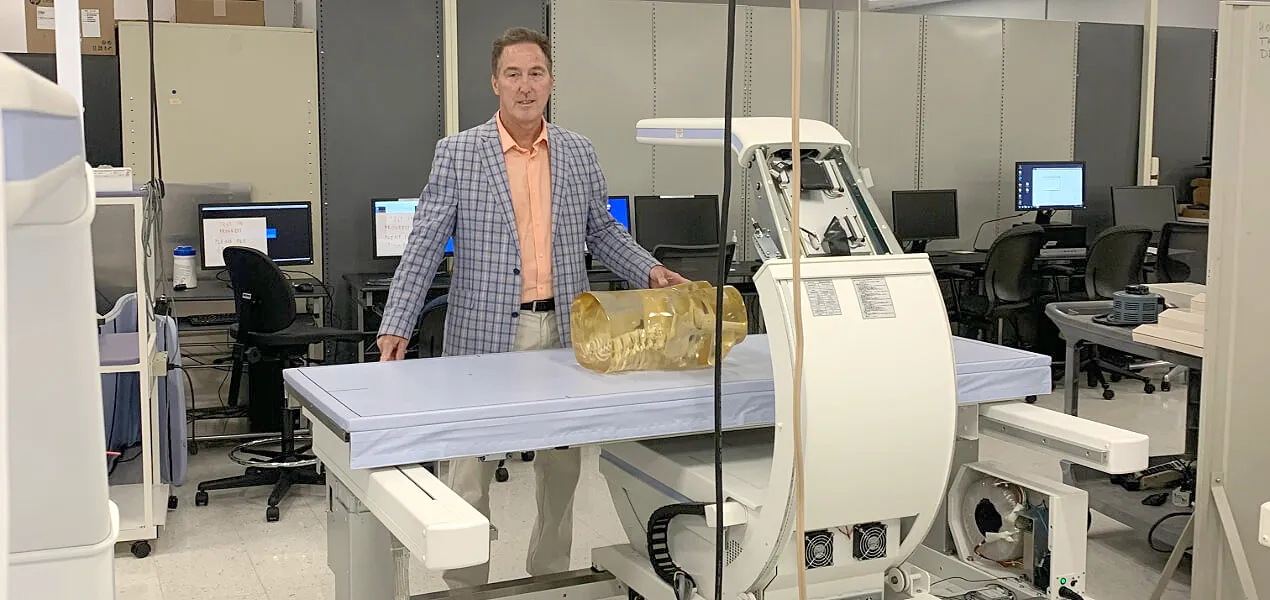
Tom Kelly stands next to a DXA system in a Hologic R&D lab.
As women age, their risk for osteoporosis rises, especially around menopause and with certain breast cancer treatments.1,2 A DXA bone density test can help detect silent bone loss.3 For nearly four decades, Tom Kelly has helped drive innovation aimed at helping women and their doctors prevent potentially life-changing bone fractures.
When Kelly first joined the company in 1987, a typical bone density exam took about 40 minutes. It used a radioactive source that decayed over time and produced low resolution images.
Today, dual-energy X-ray absorptiometry (also known as DXA or DEXA) scans such as Hologic’s Horizon® DXA system can take only a few minutes4 and use a low-dose X-ray to deliver sharp, consistent images to assess bone mineral density (BMD), fracture risk and body composition.
For millions of people — especially women, who are disproportionately affected by osteoporosis5 — that speed and precision can detect silent bone loss early when steps can be taken to protect their mobility, independence and quality of life.
Kelly, now lead R&D scientist, has helped drive DXA innovation since the company introduced the industry’s first system nearly 40 years ago. He co-developed the T-score and holds more than a dozen patents in bone densitometry, many of which helped define today’s standard of care.
The story behind the T-score
The T-score is used worldwide to help diagnose osteoporosis. Before that, clinicians mainly used the Z-score, which compares a person’s bone density to peers of the same age.
“If you’re an older woman and you’ve lost a lot of bone, your Z-score might still look normal compared to others your age,” Kelly explains. “But your bone fracture risk is higher.”
Kelly recognized this and, working with his mentor at Massachusetts General Hospital, he developed a score that compares bone density to a young, healthy population. A T-score near 0 means normal bone density, while a score of −2.5 or lower is now part of the World Health Organization’s definition of osteoporosis. Scores between −1 and −2.5 indicate osteopenia.6
This shift helped clinicians better identify people at higher risk for bone fractures.
How bone density changes for women: Menopause, age and aromatase inhibitors
As women age, their bodies tend to lose more bone mass than they gain. Estrogen also plays an important role in preserving bone density by slowing the natural breakdown of bone.
Estrogen levels dramatically fall during menopause, and bone breakdown can outpace bone formation.7 This may lead to faster bone loss around menopause, especially in common fracture sites like the spine and hip — two areas DXA aims to measure.
Breast cancer treatment can also impact bone density. For many women treated for hormone-sensitive breast cancer, therapies that lower estrogen can treat or reduce the risk of the cancer returning, but they may also increase the risk of bone loss and fractures.8
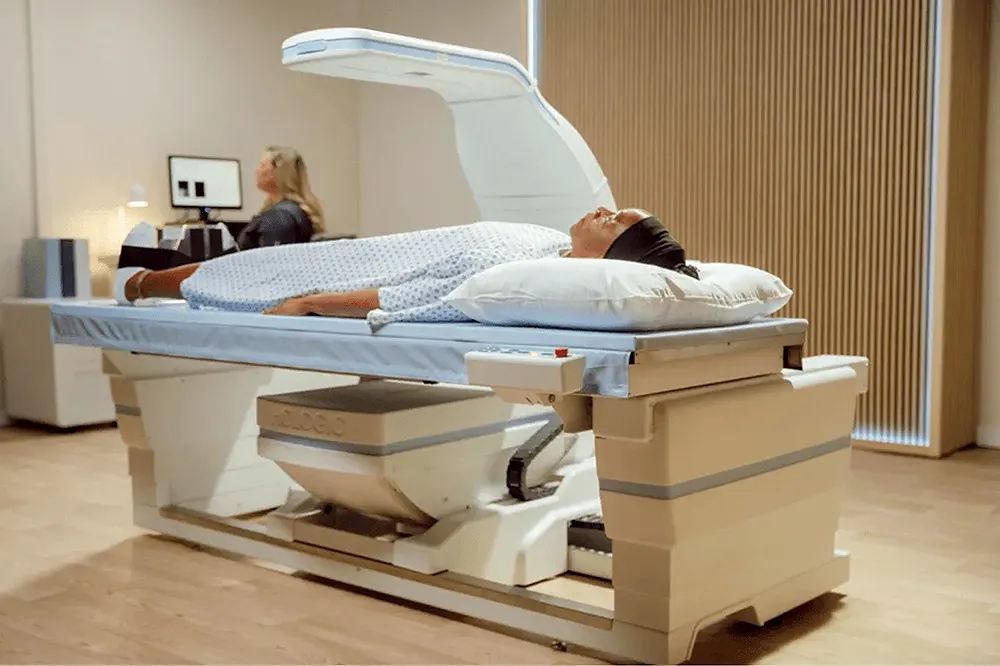
A woman undergoes a DXA scan, which may be performed during the same visit as their mammogram.
Looking at the whole risk picture
While age and estrogen levels are central to women’s bone health, they’re not the only risk factors.
The Fracture Risk Assessment Tool (FRAX), developed by the University of Sheffield, UK in conjunction with the World Health Organization, uses Hip BMD but also considers other clinical risk factors like gender, fracture history, the use of certain medications like steroids, smoking and alcohol use and others.
Hologic incorporated the FRAX calculator into its DXA systems in 2008 to give clinicians a fuller picture of fracture risk over time.9
“It’s also important to look at trends for each patient,” Kelly says. “A series of BMD measurements helps clinicians determine whether bone density is rising or falling. If a decline is seen, treatments that may prevent additional bone loss are often prescribed.”
Beyond assessing fracture risk, DXA can also give a detailed picture of body composition — levels of fat, muscle and bone. It can show where fat is stored, including visceral fat, which sits deep in the abdomen. High levels of visceral fat are linked to a higher risk of multiple health issues, including heart disease.10
A career built on curiosity — and customer focus
Kelly was initially drawn to DXA because of his love of science and the field of radiology. But for him, the appeal has always been both technical and human.
“I was fascinated by the fact that you could measure bone while it’s still in the body,” he says. “And I have a lot of appreciation for our customers, the patients they serve and the lives they help protect.”
That customer focus shows up in conversations that help drive new advances in the technology — and sometimes shape lives in unexpected ways.
During early testing of Hologic’s first DXA scanner in 1987, the team wasn’t yet releasing patient test results. A women’s health professional from Massachusetts kept calling for their patients’ bone density results.
“One of the nurses was very persistent,” Kelly remembers. “I finally said, ‘Come over to the bone density lab and I’ll show you what we’re doing.’ She came, looked around and said, ‘This is all very interesting — but what I really want are the results for my patients.’”
That nurse was Linda, who is now his wife. “It’s all because of Hologic,” he says with a smile. “And because she was doing her job.”
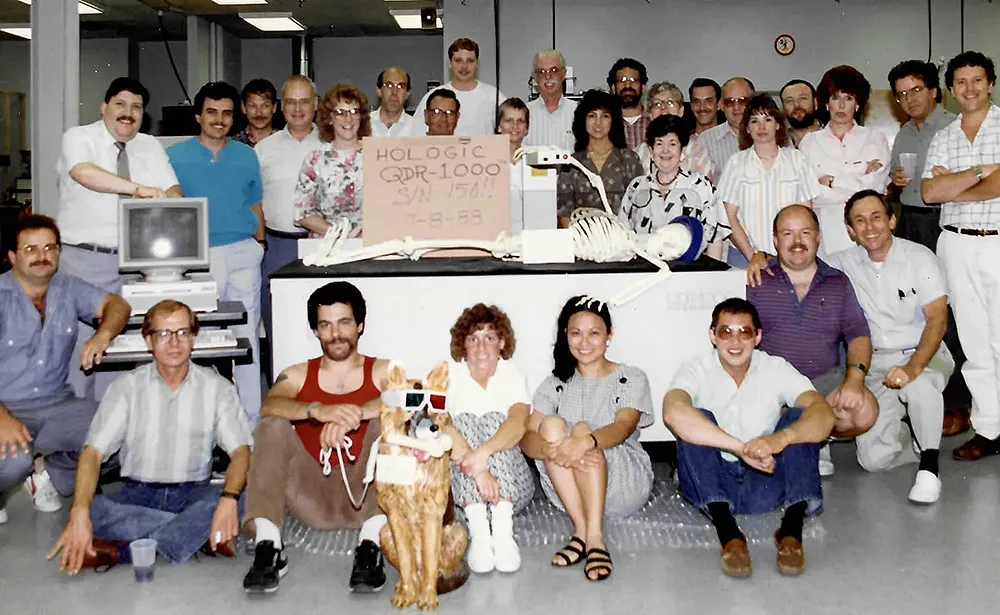
The early days of DXA at Hologic, with QDR-1000, the industry’s first system.
Protecting women’s bones, today and tomorrow
Looking ahead, Kelly expects artificial intelligence (AI) to play a big role in DXA, including standardizing analyses and reducing variation between technologists.
“Post-scan analysis still involves a lot of operator intervention,” he says. “I see AI being incorporated in several different ways, and I think it has significant potential to help standardize the technical quality of exams.”
As DXA advances with more precise measurements, richer analytics and emerging AI tools, Kelly sees the core mission staying the same.
“We’re here to give healthcare providers trustworthy information,” he says. “So they can keep people walking, independent and living their lives without the burden of avoidable fractures.”
For the many women, and men, who rely on their bones every day, that quiet progress can make all the difference.
Learn more about Hologic’s DXA technology.
- National Institute on Aging. Osteoporosis. National Institute on Aging. Published November 15, 2022. https://www.nia.nih.gov/health/osteoporosis/osteoporosis
- New guidance on the management of aromatase inhibitor-associated bone loss in women with hormone-sensitive breast cancer | International Osteoporosis Foundation. Osteoporosis.foundation. Published 2025. Accessed April 7, 2026. https://www.osteoporosis.foundation/news/new-guidance-management-aromatase-inhibitor-associated-bone-loss-women-hormone-sensitive.
- Radiological Society of North America. Bone Densitometry (DEXA , DXA). Radiologyinfo.org. Published 2020. https://www.radiologyinfo.org/en/info/dexa.
- A whole body composition scan takes as little as 2 minutes on Horizon A system, and 5 minutes on a Horizon W and Wi system. Technical Specifications MAN-03283 Rev 007.
- Alswat KA. Gender Disparities in Osteoporosis. Journal of Clinical Medicine Research. 2017;9(5):382-387. doi:https://doi.org/10.14740/jocmr2970w
- International Osteoporosis Foundation. Diagnosis | International Osteoporosis Foundation. www.osteoporosis.foundation. https://www.osteoporosis.foundation/health-professionals/diagnosis
- Thapa S, Nandy A, Rendina-Ruedy E. Endocrinal metabolic regulation on the skeletal system in post-menopausal women. Frontiers in Physiology. 2022;13:1052429. doi:https://doi.org/10.3389/fphys.2022.1052429
- Osteoporosis and Osteopenia. www.breastcancer.org. https://www.breastcancer.org/treatment-side-effects/osteoporosis.
- 510(k) Clearance, K080711.
- Wiley TMP, Poirier P, Burke LE, et al. Obesity and Cardiovascular disease: a Scientific Statement from the American Heart Association. Circulation. 2021;143(21):984-1010. doi:https://doi.org/10.1161/cir.0000000000000973.
The content in this piece is for informational purposes only and is not intended to be medical advice. Please contact your medical professional for specific advice regarding your health and treatment. This information is not intended as a product solicitation or promotion where such activities are prohibited. Because Hologic materials are distributed through websites, eBroadcasts and tradeshows, it is not always possible to control where such materials appear. For specific information on what products may be available in a particular country, please write to womenshealth@hologic.com.