

The Silent Epidemic: What to Know About STIs and Women’s Health

According to the 2026 Hologic Global Women’s Health Index, only 10% of women surveyed reported being tested for sexually transmitted infections (STIs) in the past year. STI testing is the only preventive care measure in the Index that has not seen an increase in rate since the first report in 2020.
The latest data from the Centers for Disease Control and Prevention (CDC) show that STI cases are 13% higher than a decade ago. Overall, an estimated 1 in 5 people in the U.S. are living with an STI, with people ages 15-24 accounting for nearly half of all new STIs.1-3
Because of their long-term effects on reproductive organs, STIs remain a significant — yet often overlooked — women’s health issue. Therefore, STI Awareness Month presents a critical opportunity to raise awareness of the need for routine STI screening in young women and other groups with increased risk, and to ensure that access to STI testing is integrated into the broader continuum of care regardless of what stage of life women are in.
Asymptomatic infections and overlapping symptoms complicate STI diagnoses
“STIs are often asymptomatic in women but can still be causing damage to reproductive organs,” said Dr. Kyle Bukowski, practicing OBGYN and Medical Director at Hologic.
More than four in five women with STIs report no symptoms.4 When symptoms do appear, they can mimic common conditions such as bacterial vaginosis (BV) or yeast infections.5
“Relying on symptoms alone is not enough,” said Ashley Nenninger, Senior Scientific Affairs Manager for Diagnostics at Hologic. “Between a high frequency of asymptomatic infections and symptom overlap with other conditions, STIs are often hidden. Proactive, guideline-based STI screening and comprehensive molecular testing, when appropriate, help make sure we’re not missing silent infections.”
STI screening for women: age, risk and pregnancy-based guidelines
Current screening guidelines from the CDC and U.S. Preventive Services Task Force (USPSTF) were designed to detect infections early, especially when certain infections are often asymptomatic. Annual screening is recommended for sexually active women younger than 25 for chlamydia and gonorrhea, and for women 25 and older when high-risk factors are present, such as a new sex partner or a partner with a known STI. This same guidance in screening also applies to pregnant women.6
“Age and risk-based guidelines are founded on a strong body of evidence. They help ensure women get access to appropriate testing to stay healthy and reduce the risks of potential long-term consequences from untreated infections,” said Ashley. “Getting an STI test, whether a patient asks about it or it is offered as standard screening, should feel as routine as any other preventive healthcare activity at a doctor’s visit.”
Longterm effects of untreated STIs in women include disease, infertility and pregnancy complications
Estimates suggest that approximately 24,000 women in the U.S. become infertile each year due to undiagnosed STIs.7
“Women are more physiologically susceptible to some infections than men and face more severe long-term consequences,” said Dr. Bukowski.
Chlamydia and gonorrhea, for example, can ascend from the cervix to the upper genital tract and cause pelvic inflammatory disease (PID), which is strongly linked to infertility, chronic pelvic pain and ectopic pregnancy.8 Untreated STIs can also increase the risk of acquiring or transmitting HIV.5
Among pregnant women, more than 1 in 3 who test positive for chlamydia or gonorrhea are not retested before giving birth, despite the risk of transmitting infection to the newborn.9
“Many OB-GYNs have a heartbreaking story of someone who is trying to conceive and finds out that they have infertility due to an undiagnosed STI,” said Dr. Bukowski. “Untreated infections are also associated with adverse pregnancy outcomes, preterm birth, low birth weight and stillbirth.”
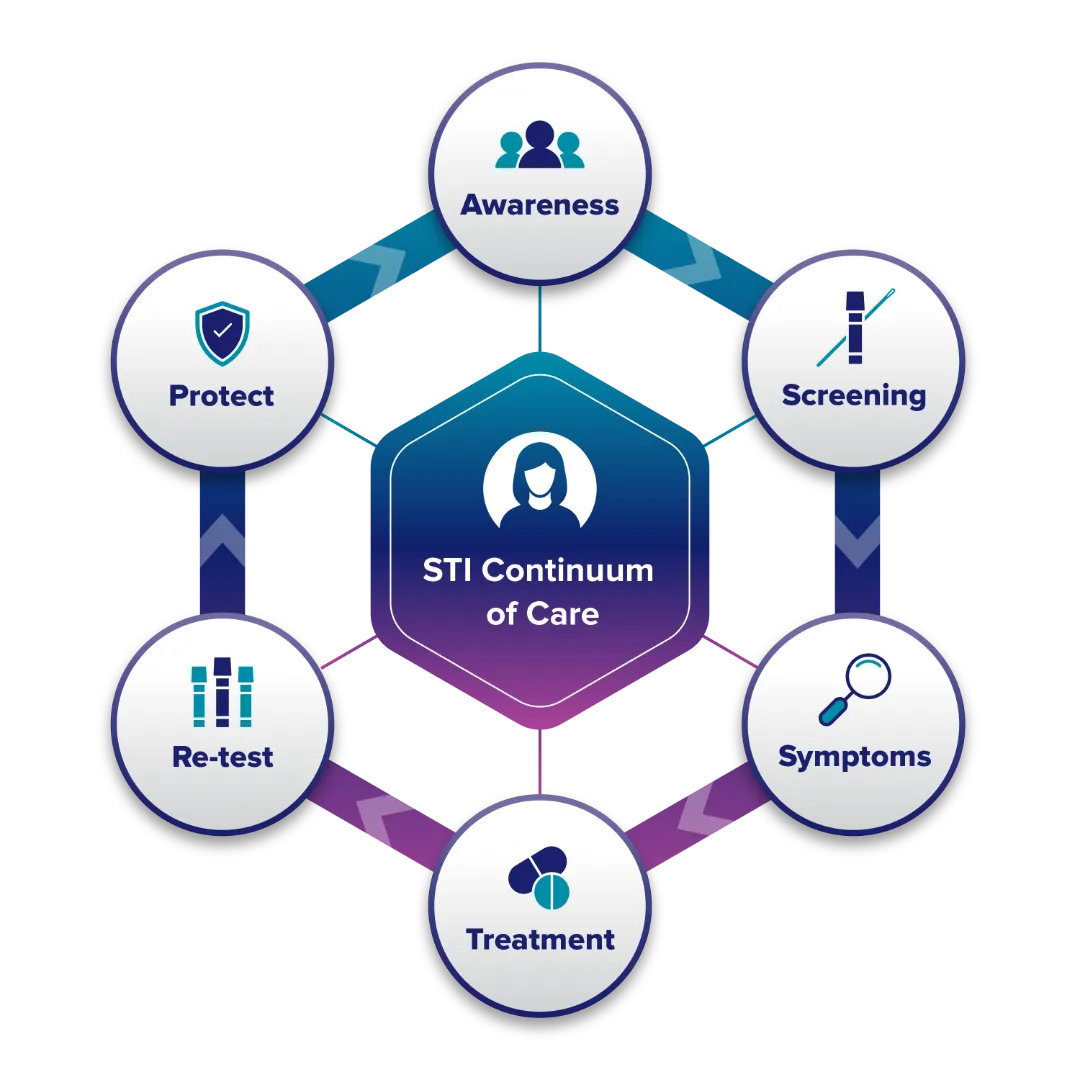
Hologic has introduced the STI Continuum of Care designed to support women’s sexual and long-term health by building awareness, helping ensure routine screening, improving symptom recognition and accurate infection diagnosis, enabling proper treatment and timely re-testing, and protecting women's health over time. Learn more.
Co-infections: why BV and STI testing should go hand in hand
BV is an imbalance in the vaginal microbiome that can range from asymptomatic to very uncomfortable. Unfortunately, co-infections between BV and STIs are common. In a large study of women with BV symptoms, one in five women had at least one STI, and women who were BV‑positive had about twice the STI infection rate of BV‑negative women.10
“Because co-infections are common, sexually active women with vaginitis symptoms should be tested for BV, trichomoniasis, yeast, and STIs to minimize the chance of missing an infection,” said Dr. Bukowski. “Comprehensive testing gives healthcare providers a much clearer picture of what’s really going on.”
Opt-out screening and one collection method to simplify STI testing
Implementing opt-out screening methods, also referred to as universal screening, can play a powerful role in improving the rate of STI testing across healthcare settings.
“Opt-out screening is about shifting the dialogue from, ‘Do you want to be screened today?’ to informing patients that a test will be performed unless they actively want to decline it,” said Dr. Bukowski. “When STI testing is routine and not made to feel exceptional, we help reduce stigma and reach women who might never ask for testing on their own.”
This approach has been shown to increase screening rates and identify more asymptomatic infections.11
Advances in diagnostic technology also now allow multiple infections to be identified from a single vaginal swab. Hologic’s Aptima® Multitest Swab can test for multiple STIs such as chlamydia, gonorrhea and trichomoniasis, as well as causes of vaginitis like BV and yeast.
“Molecular tests — specifically nucleic acid amplification tests — for STIs have been the standard of care for some time, helping revolutionize STI detection and moving us beyond the sensitivity and workflow limitations of older methods like culture,” said Ashley. “Now we have access to the same advanced diagnostic approach for vaginitis, and we can run both STI and vaginitis testing from a single sample collection. This offers greater efficiency in the clinic for patients and providers, as well in the lab.”
Retesting and partner treatment are critical to the STI continuum of care
Reinfection is also common: at least 1 in 10 women become reinfected after treatment for chlamydia or gonorrhea, and about 1 in 8 after treatment for trichomoniasis.12-13
Guidelines recommend retesting for all three of these STIs approximately three months after treatment, and continuing routine screening for women based on age, pregnancy status and risk factors.6 The CDC and American College of Obstetricians and Gynecologists (ACOG) also support testing and treatment of sexual partners, when appropriate, to prevent reinfection.5, 14
Despite this guidance, studies show that only about one third of patients receive the recommended follow up testing after a positive test result.15-18
“It is critical to set clear expectations at the time of testing that if a test result is positive, we will treat and then retest three months later to ensure the infection is resolved,” said Dr. Bukowski. “All sexual partners must be treated as well. There are some public health systems that allow for anonymous notification of sexual partners who were exposed to an STI if the patient is uncomfortable having the conversation.”
Turning STI awareness into preventive action
The data is consistent: many STIs in women are asymptomatic, untreated infections can have lasting effects on women’s health, and co-infections occur enough in sexually active women that evaluating only one condition can leave others undetected.
“STIs are common but largely preventable, and testing plays a critical role in guiding treatment and reducing transmission,” said Dr. Bukowski. “STI screening works best when systems are in place to make testing a routine part of preventive care and paired with measures like retesting and partner treatment. Only then will we be better positioned to protect women’s health for the long run.”