

Listening, Learning and Engineering New Possibilities in Fibroid Care
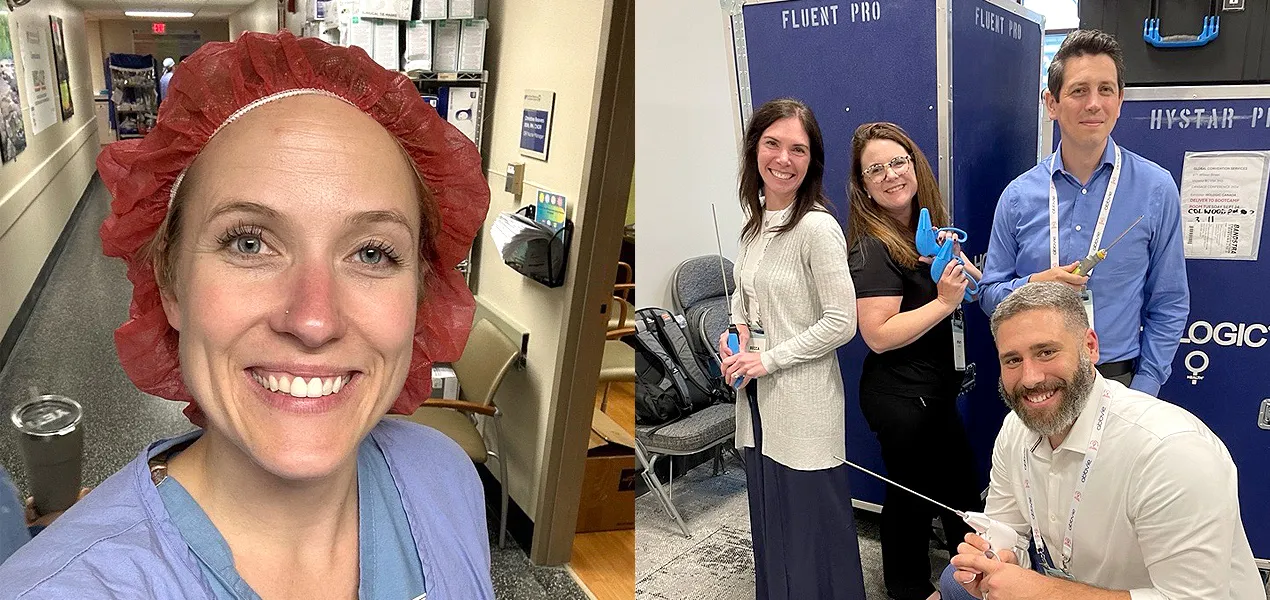
On left: Lillian Chatham at a medical facility. On right: Benjamin Hertz (front right) with members of the Hologic GYN Surgical Solutions team.
For many women, uterine fibroids can disrupt daily life: Abnormal uterine bleeding, pressure and pelvic pain.
Missed work. Missed moments with family.
These realities are a constant reminder of why innovation in fibroid care matters.
During Fibroid Awareness Month, hear from Lillian Chatham and Benjamin Hertz, two Hologic R&D engineers who are working behind the scenes to develop innovative solutions used in fibroid treatment, including minimally invasive options that may help some patients avoid more invasive procedures — such as hysterectomy — when appropriate.
Innovation Starts with Listening
For Chatham and Hertz, innovation starts with listening. They speak with physicians, observe procedures, gather feedback from the field and help translate those insights into technologies designed to support better experiences for physicians and the women they treat.
“Our job is to try to make procedures and treatments more accessible, less frightening and easier on someone’s lifestyle,” Hertz said. “That opens the door for more people to be treated for conditions that can severely impact their daily life.”
Before joining Hologic, Chatham worked in orthopedics, sports engineering and other biomedical spaces. She has long been drawn to healthcare and work that directly helps people, but moving into women’s health made the mission feel even more personal.
“Women’s health is still so underserved and has so much opportunity for growth, and I wanted to be part of that,” said Chatham. Her focus is on talking with gynecologists and other healthcare providers to help advance Hologic’s technologies that use radiofrequency ablation (RFA) — or heat — to treat fibroids, such as the Sonata® transcervical fibroid ablation system and Acessa® laparoscopic ablation system.
Turning Physician Feedback into Better Tools
For Hertz, the focus has been hysteroscopy. His team works on products that help physicians see and treat conditions inside the uterus, including the MyoSure® tissue removal device, which removes fibroids and polyps through hysteroscopy, and the Fluent® Pro fluid management system, which is designed to support fluid management and visualization during hysteroscopic procedures.
Hertz came to Hologic after more than a decade working on surgical devices in other areas of healthcare. Like Chatham, he was drawn to the chance to solve engineering problems that could help advance care for women.
"Physician feedback through direct conversation and observing them use our products is a crucial part of the process,” said Chatham. “We take those insights back into the lab to prototype, then continue to test and refine along the way.”
That feedback loop is a critical part of innovation. It helps Hologic teams understand not only what providers want from a device, but also what could make a procedure more efficient or less burdensome for the patient.
Chatham said that it is especially important in gynecology, where device design must reflect the physicians and care teams using the technology, many of whom are women themselves.
“Ergonomics are really important,” she said. “A lot of products have not always been traditionally designed for women who may have smaller hands. We want to make sure we are making products for the target audience.”
Seeing the Impact in the Procedure Room
When Hologic launched the Fluent Pro fluid management system in 2024, Hertz had the opportunity to observe some of the first cases using the system. The system was designed with updates to support quality, reliability, and user control, including increased and selectable suction compared with Hologic’s previous version.
That matters because fibroids can be dense and difficult to remove. During hysteroscopic treatment, suction helps pull tissue into the cutting window of the device so it can be removed. But increasing suction also creates another challenge: maintaining the fluid levels inside the uterus that allow the physician to see clearly.
Hertz said Fluent Pro system uses specialized technology designed to monitor and help maintain fluid in the uterus to support physician visualization, while also supporting higher suction levels.
In one case, he heard feedback that stayed with him. A physician treated a large fibroid that, with previous technology, likely would have required two procedures. With the Fluent Pro system, the physician was able to complete the case in one procedure.
“That patient doesn’t have to come back for another surgery,” Hertz said.
Why Fibroid Treatment Is Not One-Size-Fits-All
Both Chatham and Hertz said fibroid treatment is complex because fibroids vary from person to person.
“With fibroids, each and every one seems to be different,” Hertz said. “They’re different shapes, different densities, and sometimes there are calcium deposits that almost make them hard as a rock.”
That variability is one reason innovation is so important. A single approach will not meet every patient’s needs or every physician’s procedural challenges.
Quote from Benjamin Hertz
“What works well for one patient may not be an option for another because of how many fibroids they have, where they are located or other factors. That’s what’s exciting to me — advancing different options for treating fibroids so that providers and patients have choices based on an individual’s situation.”
Building Toward Care That Better Fits Women’s Lives
For Chatham, the future of fibroid care includes continued progress toward procedures that better fit women’s lives. Recovery time and lifestyle impact are important considerations, especially for women who may be raising families, managing careers or leading active lives.
With today’s minimally invasive approaches, patients may go home the same day and return to work within 4-5 days.1
“For many women, caregiving and career responsibilities can make it hard to take a lot of time off to address medical needs,” said Chatham.
For Hertz and Chatham, that future starts with the work happening now: listening, learning, testing and improving.
“I’m passionate about advancing our products and getting them in the hands of physicians,” Chatham said. “Hopefully, we can improve their experience as well as patient outcomes. That’s what keeps me excited and motivated.”
- SG Chudnoff, et al. Outpatient Procedure for the Treatment and Relief of Symptomatic Uterine Myomas. Obstetrics and Gynecology, 2013;121(5):1075-82.
The content in this piece is for informational purposes only and is not intended to be medical advice. Please contact your medical professional for specific advice regarding your health and treatment. This information is not intended as a product solicitation or promotion where such activities are prohibited. Because Hologic materials are distributed through websites, eBroadcasts and tradeshows, it is not always possible to control where such materials appear. For specific information on what products may be available in a particular country, please write to womenshealth@hologic.com.