

Behind the Science of Sure: Redefining What’s Possible in Cancer Detection with Artificial Intelligence
Artificial intelligence (AI) is reshaping the delivery of healthcare. Hear from Ashwini Kshirsagar and Sarah Harrington, who are leading efforts to bring Hologic’s AI-powered technology from the lab to the clinic, redefining what’s possible in cancer detection.
For cervical cancer and breast cancer — two of the most common threats to women’s health globally — AI offers the potential to detect disease earlier, improve access to care for patients and address radiologist and cytologist shortages worldwide.
A new approach to detecting cervical cancer
Cervical cancer is among the most preventable and curable cancers when it is caught early.1 “Cervical cancer, unfortunately, is still a leading cause of cancer death among women globally,” says Sarah Harrington, Ph.D., Director of Scientific Affairs within the Diagnostics division at Hologic. “And it shouldn’t be — because you can actually prevent cancer from even happening by detecting pre-cancerous cells, and we have the screening tools to do that.”
One major advancement in this fight is Hologic's Genius™ Digital Diagnostics System, a groundbreaking AI innovation designed to reimagine the cervical cancer screening process.
Historically, cytologists and pathologists manually reviewed glass slides containing tens of thousands of cells under a microscope — a time-consuming and labor-intensive process. “The Genius Digital Diagnostics System actually scans that slide and creates an image of it,” Harrington explains. “An AI algorithm then analyzes every cell on that slide and creates a gallery of images for a cytologist or pathologist to review. So instead of looking at tens of thousands of cells, they’re looking at 30 to 60 diagnostically relevant cells.”
By focusing attention on the most important images, the system enables faster, more accurate diagnoses. “It takes away having to find that needle in the haystack — that one rare cell that may be diseased,” Harrington adds.
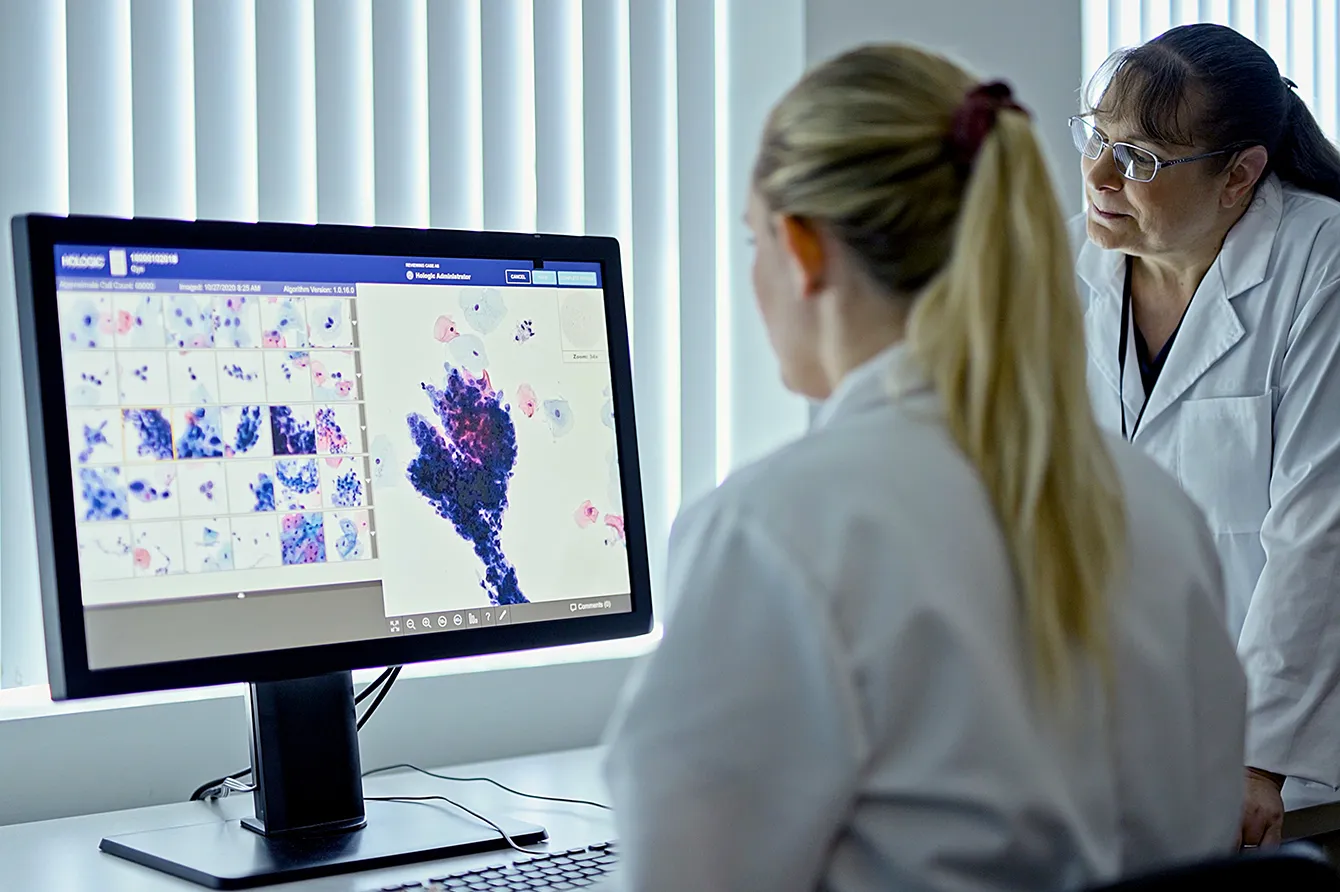
The Genius Digital Diagnostics System is reimagining cervical cancer screening with AI.
Advancing breast cancer screening technology to improve patient outcomes
AI is also transforming how radiologists detect and diagnose breast cancer. When caught early before it can spread, breast cancer has a five-year survival rate of approximately 99%.2
“AI acts as a second pair of eyes that helps radiologists find suspicious lesions. It reads images pixel by pixel and finds subtle signs of cancer,” says Ashwini Kshirsagar, Ph.D., Director of R&D within the Breast & Skeletal Health division. She is listed as a patent owner for multiple innovations related to modern AI use in breast cancer detection.
Hologic's Genius AI® Detection solution is trained on hundreds of clinical cases with known outcomes, so it knows how to look for the signs of early cancers, from nuanced patterns to the earliest indicators of disease. The AI assigns a confidence score to help radiologists assess areas of concern.
“A high score typically means there is one or more suspicious lesions, while a zero score would likely mean there’s nothing to worry about,” Kshirsagar explains, pointing out that in a study, AI was able to find one additional cancer for every 10 found by radiologists.3
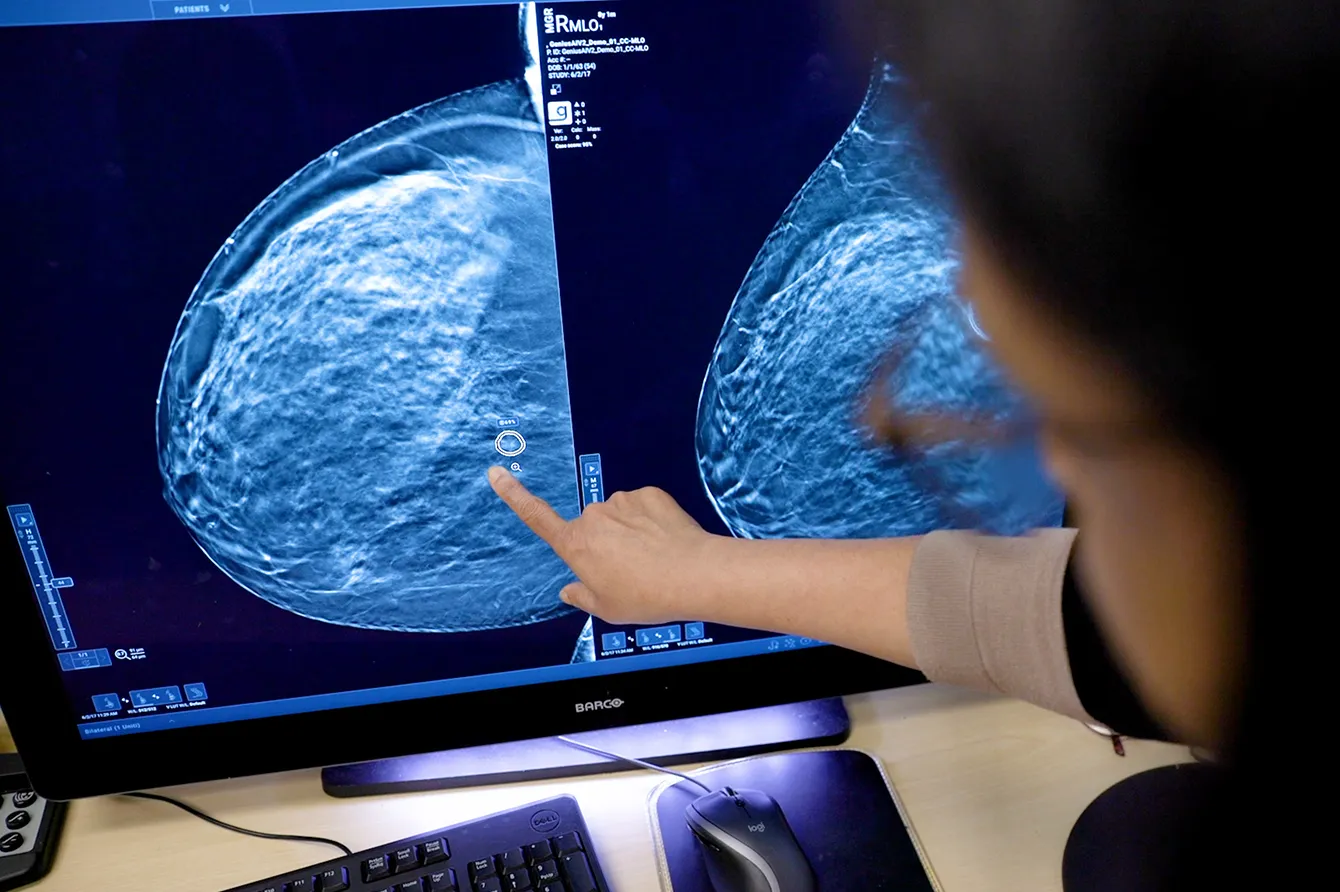
The Genius AI Detection solution flags areas suspicious for breast cancer for radiologists.
Addressing workforce shortages in breast and cervical cancer screening
The World Health Organization projects a global shortage of 11 million healthcare workers by 2030, primarily in low- and middle-income countries.4 AI can provide critical support by improving both accuracy and efficiency, helping clinicians manage increasing demands.
“There are fewer cytologists now doing the job, and there are more demands on them every day,” notes Harrington. “If we can help to make their lives more efficient and help ensure that they have very high accuracy in detecting disease, then it's a huge win for everyone.”
In breast cancer screening, to further aid radiologists in assessing cases, the new Genius AI Detection PRO solution uses a red-yellow-green color-coding system. Green cases signify that the AI has assessed a low likelihood of breast cancer, while red indicates a high likelihood. This intuitive scoring system was shown to reduce radiologists’ overall reading time by 24%.5
Expanding access to care
While improving accuracy and efficiency, AI tools also have the potential to expand access to healthcare.
“Unfortunately, a lot of people around the world don’t have access to [cervical cancer] screening,” says Harrington. “Places that don't have access to the expertise of cytologists and pathologists can actually utilize the Genius Digital Diagnostics system remotely. So, in areas where there isn't access to good screening, an expert somewhere else could potentially look at that case and make a diagnosis.”
Kshirsagar echoes this vision, calling AI a powerful equalizer in healthcare. “In rural areas where underserved populations live, there are two big challenges: one is access to the expert radiologists, and the second is women having to travel long distances for screening. Both causes can delay diagnosis, and this leads to worse outcomes,” Kshirsagar explains.
For areas where there may not be many radiologists that have specialty training specifically in breast imaging, AI can serve as a second set of eyes. And because AI can quickly flag high-priority cases, women who need to travel long distances to get screened can potentially have additional follow-up while they are still at their provider’s office, if something is found.
Quote from Ashwini Kshirsagar, Ph.D.
“With my experience of two decades in breast cancer screening, AI has transformed this field. It is helping to enhance accuracy, improve workflow efficiency and bring consistency to a lot of mundane tasks. It has huge potential to transform healthcare — from diagnosis and treatment to prevention. With its ability to predict, AI more broadly can transform healthcare from one-size-fits-all to the personalized solutions that we really need today.”
As AI continues to reshape cancer detection, Hologic’s mission remains clear: to ensure women everywhere are screened, diagnosed and treated earlier — with greater precision — no matter where they live.