

Newly published research suggests Hologic’s AI-powered technology can reduce 3D mammography reading time while maintaining diagnostic performance
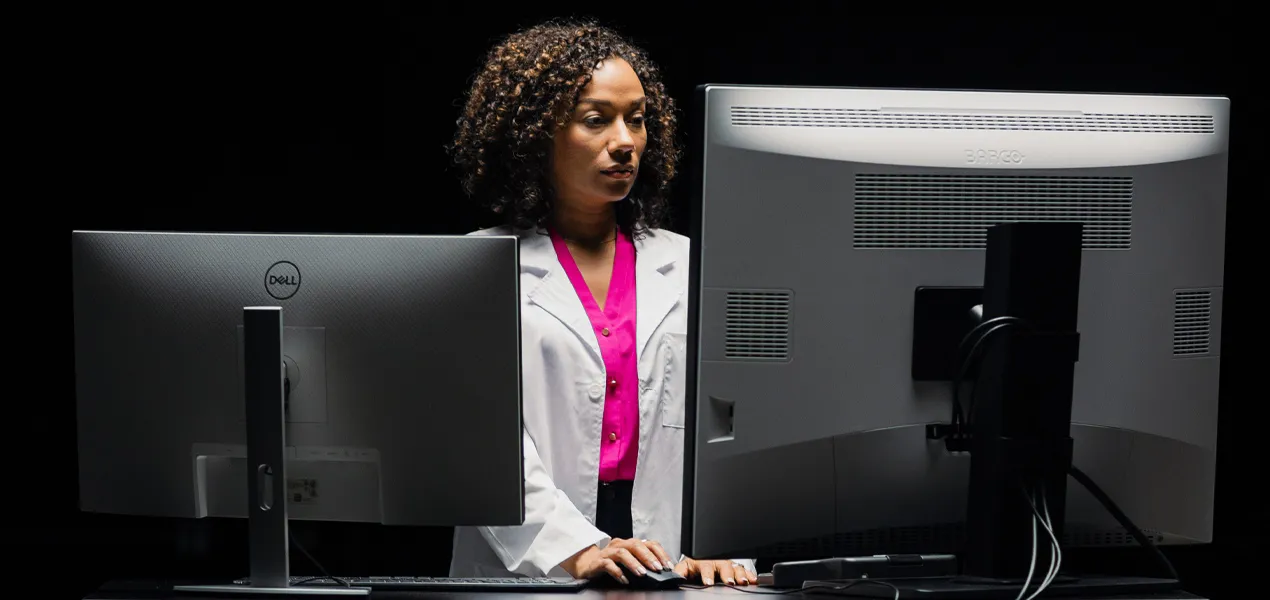
In a study just published in Clinical Radiology, Hologic’s AI-driven 3DQuorum® imaging technology reduced radiologists’ average interpretation time by 13 percent1 compared with 1 mm 3D slices, the standard of care, without impacting cancer detection performance. These results suggest that the technology may help support radiology workflow and reading efficiency at a time when many health systems are managing growing imaging volumes and workforce pressures.
3D mammography has been shown to improve breast cancer screening compared with 2D mammography,2 but it also increases the number of images radiologists must review. 3DQuorum imaging technology was designed to address this challenge.
The technology uses AI to generate 6 mm “SmartSlices” from high-resolution tomosynthesis data to reduce the total number of images for review while preserving and emphasizing important areas or regions of interest. In the simplest terms, the technology is comparable to condensing a 60-page book into a 20-page summary that retains all relevant information and highlights key findings.
The retrospective study, led by Carolynn DeBenedectis, M.D., Breast Imaging, Mass General Brigham ESG South, Professor of Radiology, UMass Chan Medical School, included 391 tomosynthesis exams collected from women undergoing mammography exams in the U.S. between January 2016 and April 2017. Fifteen radiologists assessed the clinical performance of each case, which included 160 negative cases, 27 recalls, 98 biopsy-proven benign cases and 106 biopsy-proven cancers.
The study, conducted in collaboration between external clinical investigators and Hologic's Health Clinical Affairs team, found that 3DQuorum imaging technology had similar diagnostic performance compared with the standard 1 mm 3D mammography slices, while reducing average interpretation time from 61.9 seconds to 54.5 seconds with 3DQuorum imaging technology — down 13 percent. A sub-analysis of 43 cancers presenting only as microcalcifications — tiny calcium deposits that look like white specks on a mammogram — also found comparable performance between 3DQuorum technology and 1 mm slices.
“As radiologists, our goal is to read mammography images carefully and efficiently, without compromising diagnostic confidence,” said Dr. DeBenedectis. “In this study, 3DQuorum technology reduced interpretation time while maintaining diagnostic performance compared with standard 1 mm tomosynthesis slices. These findings suggest that AI-powered smart slices may help support radiologists as screening volumes continue to grow.”
The study, titled “Comparative Efficacy of 3DQuorum 6-mm Tomosynthesis Slab Technology (SmartSlices) vs. Standard of Care 1-mm Tomosynthesis Slices: Results from a Multireader Multicase Study,” is available online in Clinical Radiology.
DeBenedectis, C.M, Kshirsagar A, Elmoufti S, Waqas M, Perez-Ortega C, Singh R. Comparative efficacy of 3DQuorum 6-mm tomosynthesis slab technology (SmartSlices) vs standard of care 1-mm tomosynthesis slices: results from a multireader multicase study. Clinical Radiology. 2026;103:107474. doi:10.1016/j.crad.2026.107474.
Friedewald SM, Rafferty EA, Rose SL, et al. Breast Cancer Screening Using Tomosynthesis in Combination With Digital Mammography. JAMA. 2014;311(24):2499–2507.
Hologic and 3DQuorum are trademarks and/or registered trademarks of Hologic, Inc. and/or its subsidiaries in the United States and/or other countries.