

New!
Clarity from the Start™
The Breast Cancer Index® (BCI®) test: The established test for extended endocrine therapy decisions. Now with new results to help set clear expectations around endocrine therapy from the beginning.

Overview
Postmenopausal
Premenopausal

A new full 0-10 year BCI report option unlocks additional results to help providers with earlier personalized endocrine therapy planning.
In addition to reporting results to help support extended endocrine therapy decision-making, a new refined 0-10 year recurrence risk assessment helps guide earlier treatment decisions.
Data-driven results based on a patient's unique tumor biology to help providers personalize endocrine therapy treatment plans.1-3
POSTMENOPAUSAL
Help Optimize Therapy Duration
Endocrine therapy: 10 years? 5 years? Even less?


PREMENOPAUSAL
Help Personalize Treatment
Ovarian function suppression (OFS)? 5 vs. 10 years of endocrine therapy?
Breast Cancer Index test results help:
- Personalize treatment when appropriate to help avoid unnecessary side effects and toxicities.
- Gain commitment to endocrine treatment plan adherence.
Navigate New Order Options
Watch the video to learn how to select the appropriate BCI test to help guide your patient's unique care.
Leverage Personalized Results to Help Guide Endocrine Therapy Decisions
Whether you order the Full 0-10 Year Report early in a patient’s treatment or the 5-10 Year Report as the patient approaches the 5-year mark, the BCI test provides valuable insights to help you personalize care.
Full 0-10 Year Report
Watch the video to learn how to leverage the new BCI Full 0-10 Year Report to help guide your patient’s endocrine therapy.
Click the links below to view example reports.
5-10 Year Report
Watch the video to learn how to leverage the BCI 5-10 Year Report to help guide extended endocrine therapy (EET) decisions.
Clear Guidance for the Next Phase of a Patient’s Treatment: Endocrine Therapy
In partnership with Living Beyond Breast Cancer, a survey of ~200 patients on endocrine therapy revealed4:
- 61% of patients said it “would have been helpful to have greater clarity from the beginning about how long they would need to take their anti-estrogen therapy”.
- 94% of patients said they “would feel more motivated to stay committed to taking their medication as prescribed if a genomic test evaluating their specific tumor biology suggested a longer duration of anti-estrogen treatment was likely to help reduce their risk of metastatic recurrence”.
Help give patients clarity and confidence with a personalized endocrine therapy plan.
Learn more about the BCI test as the established extended endocrine therapy biomarker.
For patients approaching or who have reached the 5-year mark, you may continue ordering the 5-10 Year Report option to help guide extended endocrine therapy decisions.
POSTMENOPAUSAL
Help Optimize Therapy Duration
Endocrine therapy: 10 years? 5 years? Even less?
Early Treatment Planning
Gain comfort with omission or a shorter duration of endocrine therapy to help spare patients at Minimal Risk from unnecessary side effects and potential adverse events.
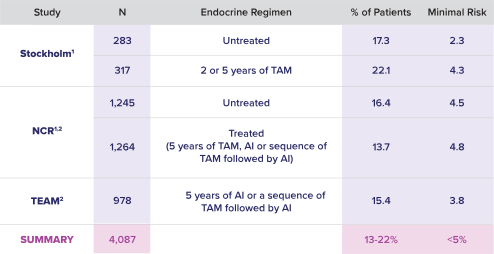
Postmenopausal, early-stage, HR+, node-negative (N0) patients identified as Minimal Risk experienced <5% average risk of 10-year distant recurrence even without adjuvant endocrine therapy.1,2
3
studies1,2
>4,000
Postmenopausal patients1,2
Level 1B
Evidence5

Setting Long-Term Expectations Early
Gain patient commitment to 5 vs. 10 years of endocrine therapy.
The BCI test is the established test for extended endocrine therapy planning. Results provide a prediction of whether the patient is likely to benefit from extended endocrine therapy and individualized risk of late distant recurrence (5-10 years) based on validation in postmenopausal patients.6-10
Order the BCI test to help give postmenopausal patients clarity around their full endocrine therapy plan from the start.

PREMENOPAUSAL
Help Personalize Treatment
Ovarian function suppression (OFS)? 5 vs. 10 years of endocrine therapy?
Early Treatment Planning
Gain comfort omitting the addition of OFS and sparing patients at Minimal Risk the potential impact of a more aggressive endocrine therapy regimen.
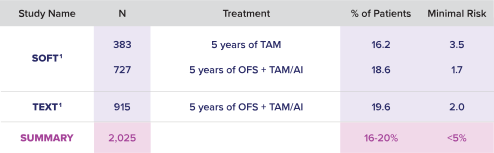
Premenopausal, early-stage, HR+, node-negative (N0) patients identified as Minimal Risk experienced <5% risk of 10-year distant recurrence even without the addition of OFS to adjuvant endocrine therapy.3
2
Landmark Studies
>2,000
Premenopausal Patients3
Level 1B
Evidence5 (SOFT, TEXT)3
Setting Long-Term Expectations Early
Gain patient commitment to 5 years of OFS and 5 vs. 10 years of endocrine therapy.
The BCI test is the established test for extended endocrine therapy planning. Results provide a prediction of whether the patient is likely to benefit from extended endocrine therapy and individualized risk of late distant recurrence (5-10 years) based on validation in premenopausal patients.6-10
Order the BCI test to help give premenopausal patients clarity around their full endocrine therapy plan from the start.
To request a meeting to review new order options now available, please complete the form below:
The Breast Cancer Index Intended Uses and Limitations
The Breast Cancer Index (BCI) test is a polymerase chain reaction (PCR) based gene expression test which analyses two gene expression signatures from formalin-fixed, paraffin-embedded (FFPE) tissue block or unstained sections on glass slides via macrodissection. The gene expression signatures include the Molecular Grade Index (MGI), a five-gene signature, and the HOXB13/IL17BR (H/I), a two-gene ratio signature. The test is indicated for use in women diagnosed with early-stage hormone receptor-positive (HR+), lymph node-negative (N0) or lymph node-positive (N1; 1-3 positive nodes) invasive breast cancer. The BCI test provides a quantitative estimate of overall (years 0-10) and late (years 5-10) distant recurrence risk and informs the likelihood of endocrine therapy benefit for women who are distant recurrence-free.
BCI results are adjunctive to the ordering physician’s workup; treatment decisions require correlation with all other clinical findings. This test was developed, and its performance characteristics determined by Biotheranostics, Inc. It has not been cleared or approved by the U.S. Food and Drug Administration. This test is used for clinical purposes and should not be regarded as experimental or investigational. How this information is used to guide patient care is the responsibility of the treating provider. Biotheranostics is certified under the Clinical Laboratory lmprovement Amendments of 1988 to perform high complexity clinical laboratory testing.
© 2026 Hologic, Inc. All rights reserved. Hologic, Biotheranostics, Breast Cancer Index, BCI, Clarity from the Start, and associated logos are U.S. trademarks and/or registered trademarks of Hologic, Inc. and/or Biotheranostics, Inc. All other trademarks are the property of their respective owners.
- Jilderda MF, et al. Clin Cancer Res. 2025;3;31(11):2222-2229.
- Jilderda MF, et al. npj Breast Cancer. 2026;12;21.
- O'Regan RM, et al. Breast. 2026;86:104714.
- Data collected from 192 early-stage, HR+ breast cancer patients in an online survey conducted by Living Beyond Breast Cancer.
- Simon RM, et al. J Natl Cancer Inst. 2009;101(21):1446-1452.
- Zhang Y, et al. Clin Cancer Res. 2013;19(15):4196-4205.
- Sgroi DC, et al. J Natl Cancer Inst. 2013;105(14):1036-1042.
- Bartlett JMS, et al. Clin Cancer Res. 2022;28(9):1871-1880.
- Noordhoek I, et al. Clin Cancer Res. 2021;27(1):311-319
- Mamounas EP, et al. Clin Cancer Res. 2024;30(9):1984-1991.