

Meet the Hologic Innovators Shaping the Future of Mammography
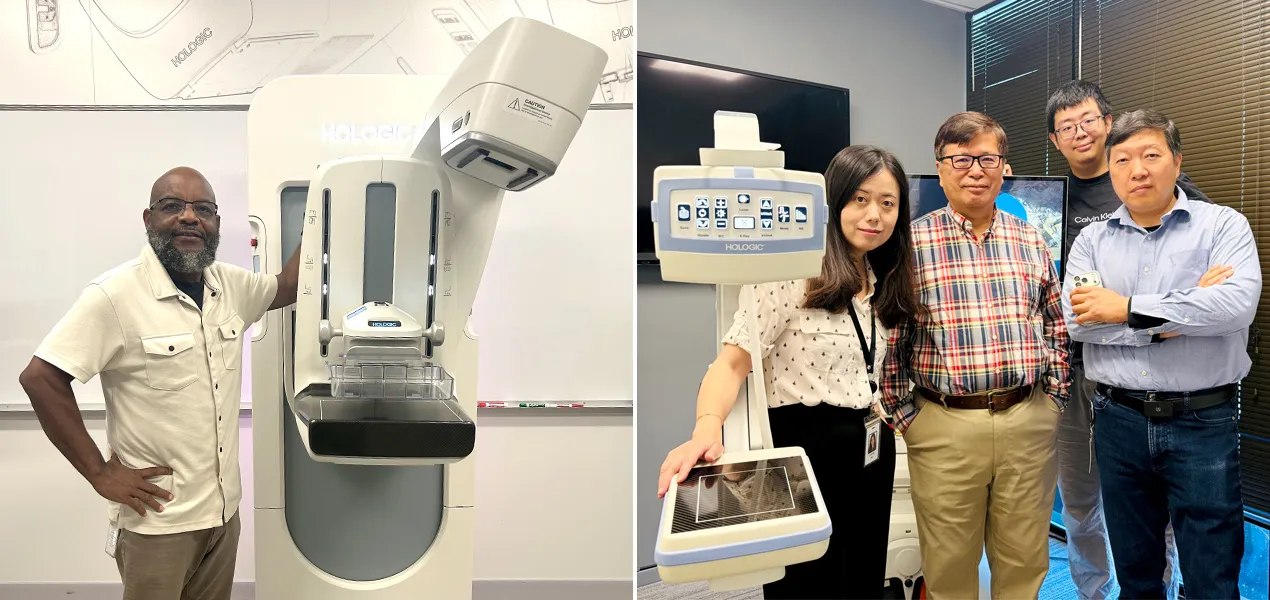
Left: Cornell Williams. Right: Xiangwei Zhang (far right) and members of the Hologic Breast & Skeletal Health R&D team.
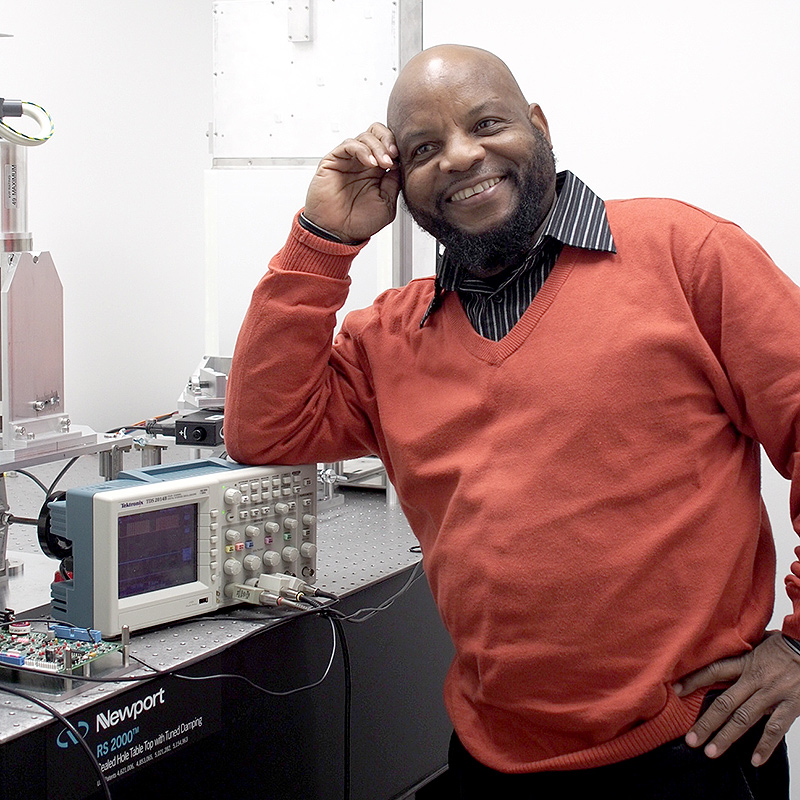
Cornell Williams still remembers the first signal. It came from a simple lab experiment. An X-ray pulse hit a small piece of selenium. A small blip appeared on a screen.
At the time, digital mammography was still in its infancy. But to Williams and his team, that signal represented something much bigger: possibility.
Decades later, that same mindset continues to drive breast imaging innovation at Hologic. It can be seen in the technology that captures the image, the AI-driven tools that support radiologists and the design improvements that help technologists and patients through the mammography exam.
Williams and his colleague Xiangwei Zhang, Associate Director of R&D, each bring a different area of expertise to that work. Together, their stories show how mammography innovation is shaped not only by their passion for technology, but by a shared focus on the people it is designed to help.
From tiny signals to clearer images
Williams, now Chief Research Engineer, has spent more than 40 years advancing the technology inside Hologic’s mammography systems.
His work focuses on the “readout sequence” — the set of instructions that tells a digital detector how to gather tiny electrical signals and turn them into the information needed to create a mammography image. The readout sequence acts as the conductor, orchestrating the system components during mammographic image capture.
Over the years, Williams has contributed to at least 50 inventions in breast imaging, including advancements in digital imaging and contrast-enhanced mammography, and the Selenia® Dimensions® system, the groundbreaking first FDA-approved 3D™ mammography system. His name is listed on over 40 patents.
But for Williams, the work has always been about the people.
A colleague once came to him in the lab and thanked him for helping save his wife’s life. Her breast cancer had been detected using a Hologic system. The colleague knew Williams had contributed to the technology behind it.
“I will never forget that,” Williams said.
He also thinks often about his own family.
“Hologic is a women’s health company, and I have seven daughters,” Williams said. “That is not a coincidence to me. Whatever I do, I think about them.”
Using AI to support breast cancer detection
If Williams’ work starts with capturing the signal, Xiangwei Zhang’s work focuses on making that signal meaningful for radiologists. His team aims to turn complex image data into clearer images and explores how AI can support their review by flagging suspicious areas amid rising caseloads and workforce shortages.
Drawing on provider feedback, Zhang has helped advance several breast imaging technologies, including C-View™, Intelligent 2D™, 3DQuorum® Imaging Technology and Genius AI® Detection. For Zhang’s team, the goal is to give radiologists clearer, more useful information as they look for signs of breast cancer.
“If we improve the image quality and help make radiologists more confident, that ultimately benefits the patient,” Zhang said.
Innovation built around the radiologist’s needs
One of the clearest examples of customer-driven innovation Zhang recalls was the creation of C-View. When 3D mammography was introduced in the 2010s, it gave radiologists a new way to look at breast tissue. Instead of one flat 2D image, the system captured images from multiple angles and created a layered view of the breast.
But many radiologists still value having both 2D and 3D images available for review, which raised questions about additional X-ray exposure when two sets of images were taken.
That feedback helped inspire C-View, Hologic’s first synthesized 2D imaging product. The technology uses 3D mammography data to create a computer-generated 2D image that can be compared with a woman’s prior 2D scans. Besides minimizing the patient’s radiation exposure, this technology can help improve workflow efficiency for the radiologist.
“That was really exciting,” Zhang said. “We created something that had never been seen before.”
After C-View reached customers, radiologists shared more feedback. They wanted improved image quality, fewer distracting findings and images that looked more familiar when compared with prior exams. Those insights helped lead to Intelligent 2D.
Later, Hologic introduced 3DQuorum Imaging Technology, an AI-powered tool designed to reduce the number of images radiologists need to review while preserving important information. Multiple studies, including a recent study in Radiology, suggest 3DQuorum’s potential to help streamline mammography reviews while maintaining high effectiveness in finding cancer.
“With fewer image slices, the reading burden is much smaller,” Zhang said. For radiologists facing growing workloads, that can help support reading efficiency.
A shared purpose
For Williams and Zhang, the work takes different forms, whether it’s capturing the tiny signals that become a mammography image, or turning complex data into clearer information for radiologists.
But the purpose is the same: to improve breast imaging for the people who depend on it.
Their stories show that the future of mammography is defined not by technology alone. It is driven by the people behind it — and by the patients whose care it supports.